
Case Studies
Applied Performance Work
These examples show how testing, monitoring, and analysis were used to improve training and performance decisions in real-world environments.
The focus is on decision quality, repeatability, and practical use — not data volume.
Large-Group Hockey Testing Protocol Optimization
At a glance: 20+ teams · 200+ athletes · Testing time reduced from over a week to less than an hour.
Context
Multi-team hockey environment supporting 20+ teams and over 200 athletes during the Summer and Fall of 2025.
Problem
High athlete volume led to long testing days, inconsistent protocols, and large datasets that were difficult for coaches to interpret. Early testing batteries produced more data than actionable decisions.
Action
The testing system was rebuilt multiple times into a condensed, standardized battery focused on a small number of high-value metrics. Automated summaries were created to flag readiness and priority focus areas immediately after testing, while maintaining consistency across teams.
Outcome
Testing time was reduced from over a week to less than an hour, and coaches could make immediate, consistent training adjustments. Coaches received clear, actionable outputs instead of large spreadsheets, enabling consistent application across teams and seasons.
Sample Output
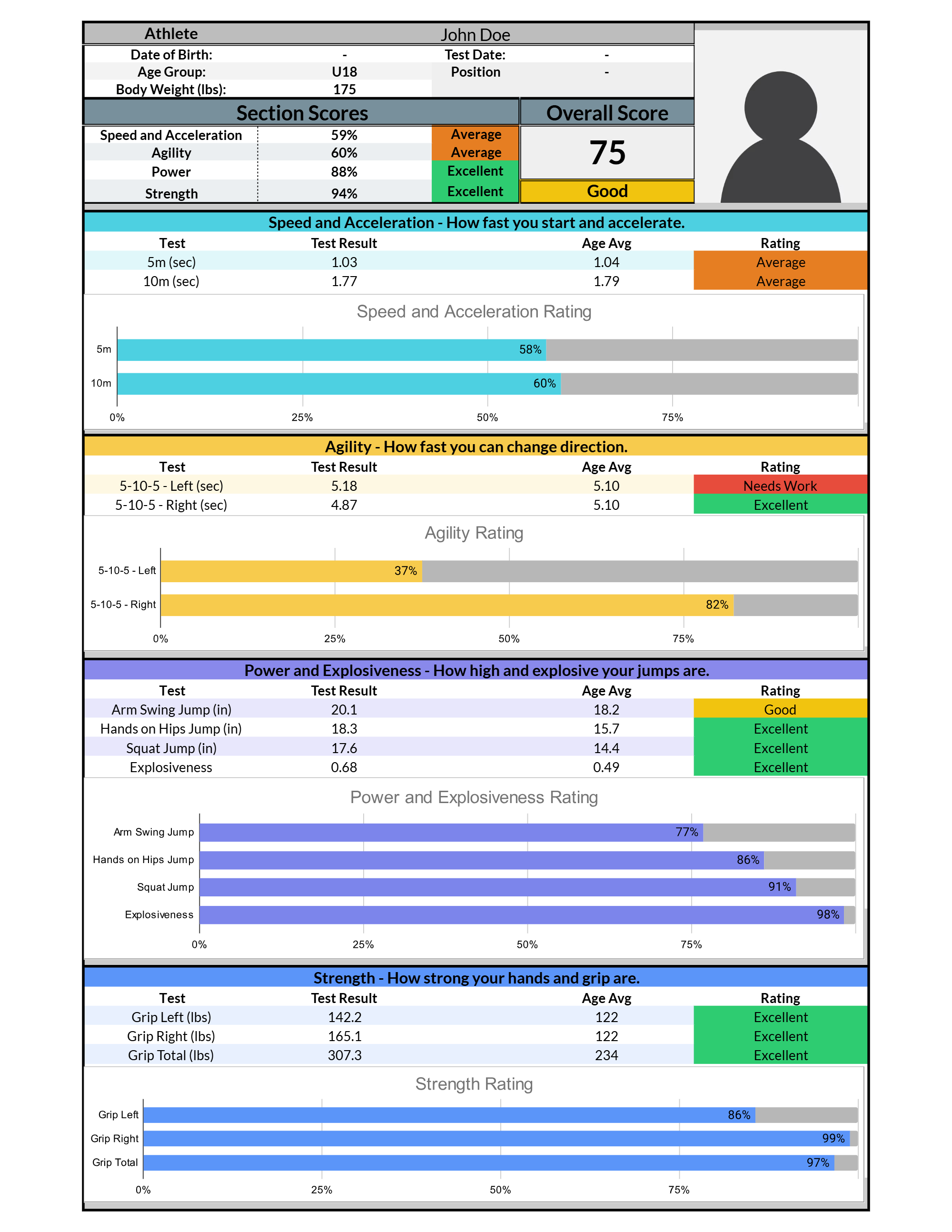
Sample output: Condensed team testing dashboard used to identify readiness concerns and priority focus areas immediately after testing.
Individual Track Athlete Assessment
Decision impact: Testing was narrowed to the physical qualities most likely to influence training priorities.
Context
An individual track and field athlete during a focused training phase following the 2024/25 indoor season.
Problem
Performance testing produced mixed results, making it unclear which physical qualities should be prioritized in training.
Action
A targeted assessment was used to identify key limiting factors rather than expanding the test battery. Results were interpreted to determine the most impactful change in training focus.
Outcome
Testing identified strength limitations at the hip and ankle, while hip extensor strength was within optimal ranges. Limitations in ground contact characteristics and explosiveness were also identified as suboptimal for high-performance sprinting. Training was adjusted to target these deficits while maintaining and optimizing power and resilience in the hip extensors.
Return-to-Performance Monitoring
Decision impact: Objective checkpoints helped the athlete and physiotherapy team progress training with clearer control over timing and risk.
Context
An athlete returning to training following a surgically repaired upper hamstring rupture.
Problem
Return-to-performance decisions are needed to balance the risk of reinjury with the opportunity to progress training efficiently. Subjective readiness alone was insufficient to guide progression.
Action
Periodic performance testing was used to benchmark key stages of the return-to-training process. Objective markers were tracked across phases to inform when progression could be safely accelerated rather than delayed. Findings were shared with the physiotherapy team to align return-to-training decisions and progression timing.
Outcome
Progression decisions were guided by the accelerated return of specific performance metrics, allowing training timelines to advance while maintaining control over risk and athlete confidence.
Facing a Similar Performance Question?
Discuss how a focused testing, monitoring, or analytics approach could fit your environment.